Kindwell Money · Guide
How to Do a No-Spend Month (and Actually Stick to It)
A no-spend month sounds intense. Done right, it's actually one of the easiest ways to reset your spending and save a few hundred dollars — without a complicated budget.
What a no-spend month really means
A no-spend month is a set stretch of days where you only pay for true essentials — rent, utilities, groceries, gas, medicine — and pause everything else. No takeout, no impulse buys, no “treat yourself” spending. Every day you don’t spend is money that stays in your pocket.
The point isn’t to be miserable for 30 days. It’s to break the autopilot habits — the daily coffee, the random Amazon cart, the “we’ll just grab dinner” — that quietly drain hundreds of dollars a month.
Step 1: Set your own rules (this is the secret)
Most no-spend challenges fail because the rules are vague. Before you start, write down exactly what counts as essential and what doesn’t. Be specific:
- Always allowed: rent/mortgage, utilities, groceries, gas, prescriptions, existing bills.
- Not allowed: takeout, coffee out, clothes, gadgets, impulse buys, subscriptions you can pause.
- One planned exception: give yourself one pre-decided exception (a friend’s birthday, say) and write it down so it stays honest.
Clear rules turn “should I buy this?” into a simple yes/no — which is exactly what keeps you on track.
Not ready to buy anything? Start free.
Grab the free one-page Paycheck Starter — a simple budget for your very next paycheck.
Get the free Paycheck Starter →Step 2: Pick a length that won’t scare you off
Thirty days is the classic, but it’s not magic. If a full month feels like too much, start with a no-spend week or a two-week sprint. A challenge you finish beats a perfect one you quit on day four. You can always run it again.
Step 3: Track every day — because seeing it works
Willpower fades. A visual scoreboard doesn’t. The single biggest predictor of finishing a no-spend month is simply marking each day. When you can see a row of green “no-spend” days building up — and a running total of money saved — you don’t want to break the streak.
That’s the whole idea behind our tracker: mark each day no-spend or spent, and it counts your streak, your success rate, and the cash you’ve saved, with a calendar that fills in green as you go.
Beating the hard days
Day 3 to 10 are the toughest. A few things that help: plan your meals so “there’s nothing to eat” never sends you to takeout; unsubscribe from store emails for the month; and keep a “want” list — when you feel the urge to buy something, write it down instead. Most of the time the urge passes, and you’ve got a ready list for after the challenge.
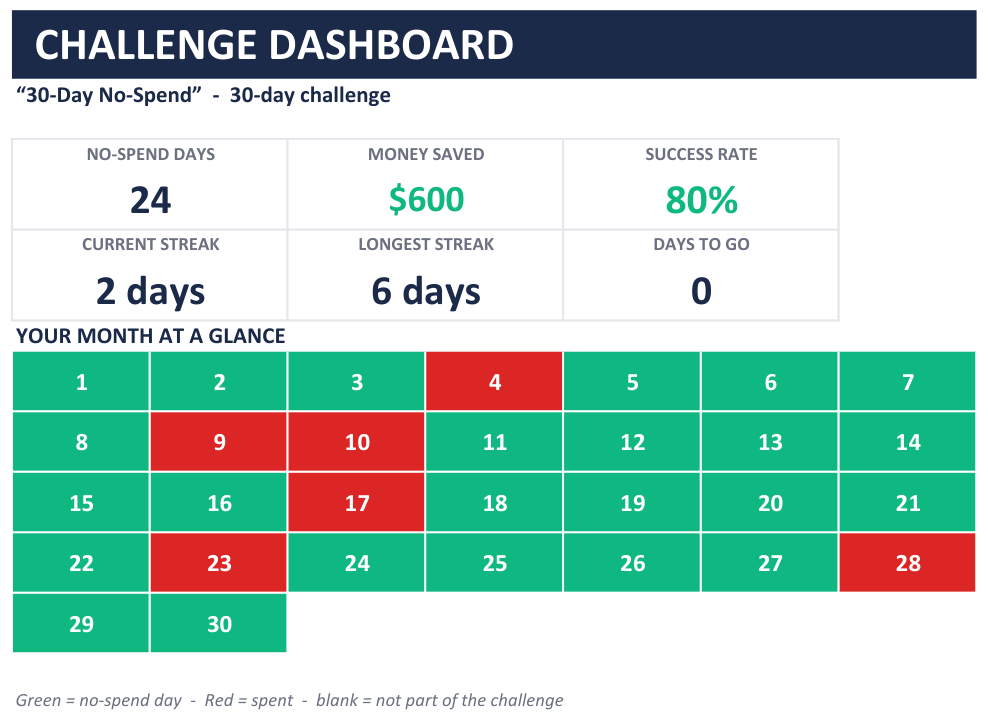
No-Spend Challenge Tracker
Color in every no-spend day, build your streak, and watch the money you save stack up.
$4 · instant download · Google Sheets & Excel